
Author: Kim-Char Meredith

  • The Three Wise Monkeys: Ancient Wisdom for Modern Enlightenment 🐵✨

    The Three Wise Monkeys: Ancient Wisdom for Modern Enlightenment 🐵✨

    The phrase “See no evil, hear no evil, speak no evil” holds a gentle yet profound ancient wisdom, offering a time-tested practice for guarding your mind, shaping your focus consciously, and wielding your words with powerful intention. If you’re seeking a grounded, uplifting reset that feels both timeless and surprisingly practical, tap the button below to journey through the interactive “Three Wise Monkeys Experience,” exploring each gift of wisdom one page at a time.

    Have you ever wondered about the deeper meaning behind “See no evil, hear no evil, speak no evil”? It’s not just a cute saying—it’s a profound spiritual teaching that can transform your life. Let me share this beautiful wisdom with you.

    Meet Your Teachers

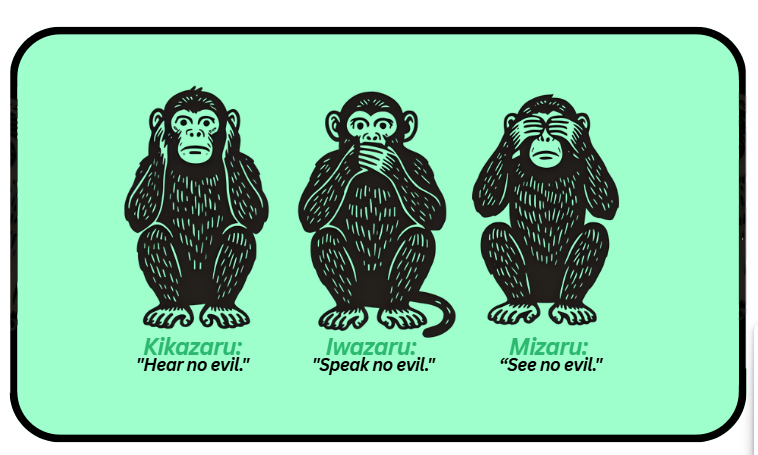
    Three humble monkeys—Mizaru, Kikazaru, and Iwazaru—have silently reminded us of our highest potential for centuries. Together, they’re known as sanzaru in Japanese, and here’s what delights me most: their very names contain a playful pun! The suffix -zaru (meaning “not”) sounds like saru (monkey). The universe wove wisdom right into the language. ✨

    A Brief History

    These beloved teachers are carved into a storage building at the Toshogu Shrine in Nikkō, Japan—a sacred sanctuary that has preserved this 17th-century wisdom through the ages. What’s beautiful is how universal this teaching is: ancient China’s Confucian tradition teaches something nearly identical. Truth echoes across cultures and centuries.

    “Truth is not confined to set creeds or sects, but is the heritage of each soul.” — Ernest Holmes, “The Science of Mind”

    The Three Gifts

    👀 See No Evil: Choose What You Focus On

    What you focus on expands in your consciousness. When you stop dwelling on negativity and flaws, you genuinely raise your vibration. This isn’t about burying your head—it’s about choosing to see potential in people and situations instead of problems.

    “The law of attraction is this: You don’t attract what you want. You attract what you are.” — Dr. Wayne Dyer, “The Power of Intention”

    “Whatever we plant in our subconscious mind and nourish with repetition and emotion will one day become a reality.” — Earl Nightingale, “The Strangest Secret”

    👂 Hear No Evil: Guard Your Sacred Mind

    Your mind is sacred ground. In our noisy world, protecting your inner space from gossip and negativity is an act of self-love. You can say “no” kindly and compassionately.

    “You are today where your thoughts have brought you; you will be tomorrow where your thoughts take you.” — James Allen, “As a Man Thinketh”

    “Every thought of yours is a real thing—a force.” — Prentice Mulford, “Thoughts Are Things”

    🤐 Speak No Evil: Your Words Create Worlds

    Before you speak, pause and ask: “Is this kind? Is it true? Is it necessary?” Your words ripple outward, shaping both your reality and the collective consciousness. When you choose encouragement over criticism, you’re literally creating a better world.

    “The words you speak become the house you live in.” — Hafiz

    “Your word is your wand. The words you speak create your own destiny.” — Florence Scovel Shinn, “The Game of Life and How to Play It”

    The Real Magic: It’s About Choosing, Not Avoiding

    Here’s the heart of it, my friends: This teaching isn’t about what you turn away from—it’s about what you consciously choose instead.

    Instead of focusing on evil, you choose to see potential.
    Instead of absorbing negativity, you choose to hear wisdom.
    Instead of spreading harm, you choose to speak love.

    “You are not a helpless victim of your own thoughts, but rather a master of your own mind.” — Louise Hay, “You Can Heal Your Life”

    “Change your thoughts and you change your world.” — Norman Vincent Peale, “The Power of Positive Thinking”

    This is the transformative power of the Three Wise Monkeys.

    Three Simple Practices

    ✨ Start your day intentionally – Ask yourself: “What will I choose to see, hear, and speak today?”

    “The first hour of the morning is the rudder of the day.” — Henry Ward Beecher

    ✨ Set loving boundaries – Say no to conversations and content that drain you. This is wisdom, not selfishness.

    “When you say ‘yes’ to others, make sure you are not saying ‘no’ to yourself.” — Paulo Coelho

    ✨ Listen to your inner voice – Speak to yourself with the same kindness you’d offer your dearest friend.

    “Talk to yourself like you would to someone you love.” — Brené Brown

    The Invitation

    Every moment offers you a choice. You have the power to align with higher principles—through every glance, every conversation, every thought. By raising your own consciousness, you’re not just transforming your life; you’re contributing to humanity’s spiritual evolution.

    The Three Wise Monkeys are calling to you with gentle wisdom: You are more powerful than you know.

    “The day you decide that you are more interested in being aware of your thoughts than you are in the thoughts themselves—that is the day you will find your way out.” — Michael Singer, “The Untethered Soul”

    ✨ What will you choose to see, hear, and speak today?

  • Could Community Be Our Most Sacred Spiritual Practice?

    Could Community Be Our Most Sacred Spiritual Practice?

    Recognizing the Divine in Community

    I’ve been deeply moved by a series of articles by Luke Healy on the spiritual practice of community.

    Healy makes a compelling point: community isn’t simply a social gathering or a convenient spiritual container—it’s a genuine spiritual practice. When we show up authentically, we collectively recognize our interdependence and encounter the Divine through meaningful engagement with one another.

    This is what shifts when we truly see Christ expressing through each other. We move beyond passive assembly into something more sacred—a real recognition of who we are, both as individuals and as a connected whole.

    Healy eloquently defines community not as “a passive gathering, a social amenity or a container for individual spiritual work,” but as “an active, essential and mystical spiritual practice where individuals collectively realize their interdependent divine nature and encounter the divine through purposeful engagement with each other.”

    Shifting Our Perspective

    To understand community as spiritual practice may require breaking down some deeply ingrained assumptions:

    First, we can release the notion that spirituality is primarily an individual pursuit. While we each carry the Christ within us individually, the fullest expression of this divine spark happens when it meets and recognizes itself in others. Our Western culture celebrates the lone seeker, but what if the Christ within us is most fully realized in communion with others?

    Second, we can recognize that discomfort in community isn’t a sign that something’s wrong—it’s often evidence that something is deeply right. When Thomas Merton writes that “true community is not just a gathering of individuals, but a revelation of our deeper unity,” he’s pointing to how community reveals our shared Christ-nature. This recognition can be uncomfortable precisely because it challenges our separate sense of self.

    Third, we can understand that community isn’t just about support—it’s about transformation. When we truly engage with others as the Christ engaging with the Christ, allowing the Divine Love within us to recognize and honor the Divine Love in others, we participate in a kind of alchemy that changes everyone involved.

    Finally, we can see that community isn’t something we attend or join—it’s something we practice as an expression of our Christ-nature. Like meditation or prayer, it requires intention, presence, and consistent engagement, even when (especially when) it’s difficult.

    Practicing Divine Recognition

    So how do we actually do community as spiritual practice? Here’s a framework I’m finding helpful:

    1. Presence Before Purpose: Begin by simply being fully present with others, recognizing the Christ in them and in yourself. Before trying to “do” anything in community, practice the art of showing up completely—mind, body, and spirit engaged with the Divine Love before you.
    2. Vulnerability as Spiritual Discipline: Share not just your insights and strengths but your questions and struggles. True community forms when we allow our Christ-nature to be seen even in our incompleteness and humanity.
    3. Sacred Listening: Develop the capacity to listen not just for information but for the Christ speaking through others. This means listening beyond words to the deeper currents of Divine Love moving in each person.
    4. Embrace Conflict as Teacher: When tensions arise (and they will), don’t flee or fight. Instead, approach conflict as a doorway to deeper understanding and connection, remembering that the Christ in you is meeting the Christ in the other, even in disagreement.
    5. Celebrate Interdependence: Regularly acknowledge and honor the ways your Christ-nature is shaped by and dependent upon others. Practice gratitude for how community helps you recognize and express more fully the Divine Love you are.
    6. Ritualize Connection: Create intentional practices that honor the sacredness of your relationships—shared meals, meaningful conversation, collaborative service—all as expressions of the Christ meeting the Christ.

    This isn’t easy work. It’s far simpler to treat community as a pleasant addition to our individual spiritual lives rather than seeing it as the Christ in corporate expression. But I’m becoming convinced that if we want to experience the fullness of our Christ-nature, we must be willing to find it not just within ourselves but between ourselves—in the beautiful, sometimes messy practice of true community.

    What might change if we approached every relationship, every gathering, every conversation as not just an opportunity for spiritual practice but as the Christ in us meeting the Christ in others? Perhaps we might discover, as Merton suggests, not just a collection of individuals but a revelation of our deeper, divine unity—the Christ expressing through our collective being.

    Malama Kekahi – that’s really the foundation of who we are as a community coming together, isn’t it? The idea that we are the Christ individually and corporately. I’m grateful to be exploring this spiritual practice of community with all of you, and I look forward to continuing our journey of divine recognition together.

    A Practice for Seeing the Christ in Community

    The Silent Namaste Practice
    Before engaging in conversation with another person, take a brief moment to silently acknowledge the divine presence within them. Mentally bring your hands to your heart center as if in the namaste position, and inwardly say, “The Christ in me recognizes and honors the Christ in you.” Notice how this simple internal gesture shifts the quality of your interaction.